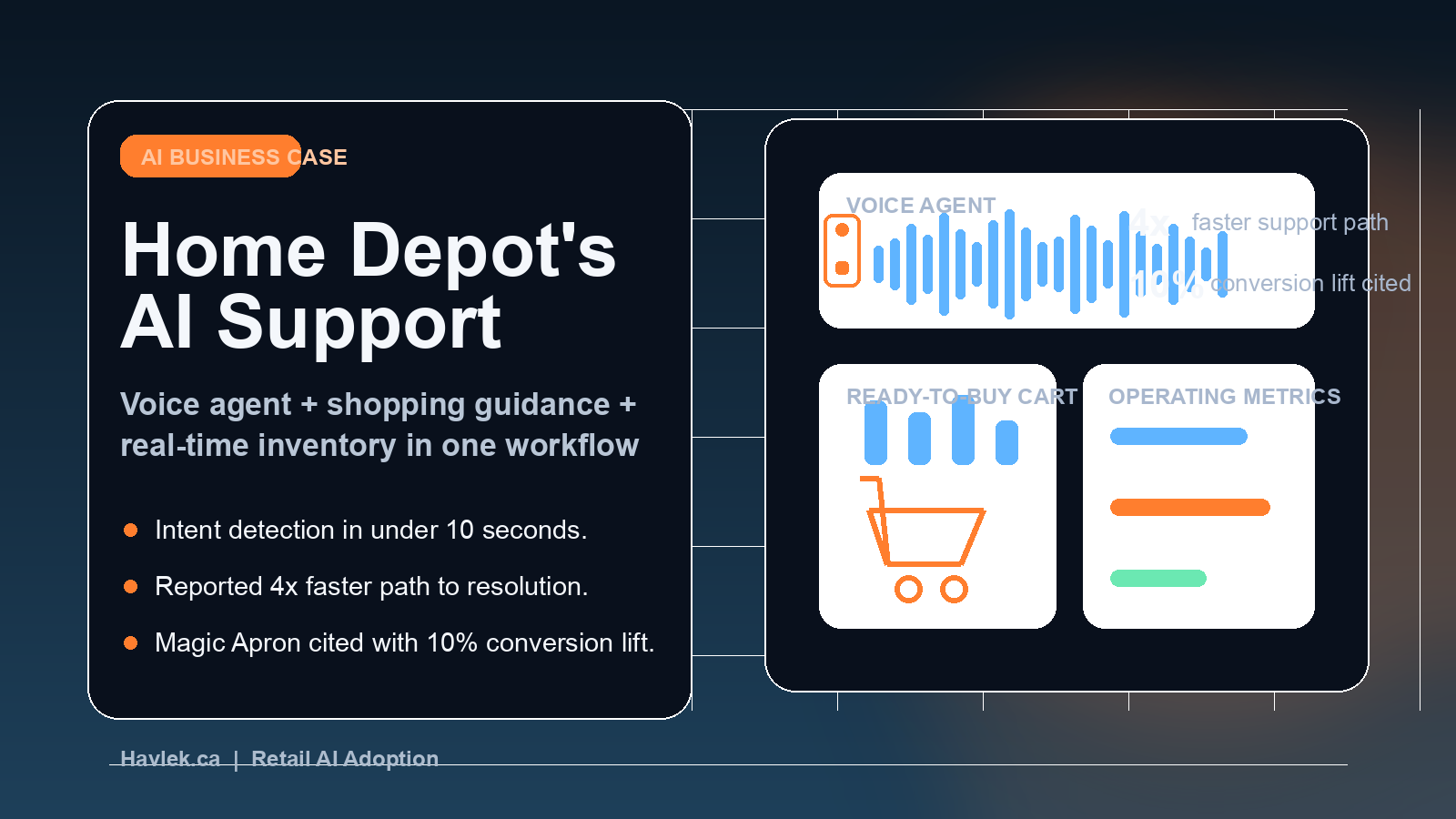
One of the cleaner recent AI business cases in retail is coming from Home Depot. What makes it useful is not that the company launched another chatbot. It is that, in April 2026, Home Depot tied AI directly to the customer journey in two places where friction normally kills momentum: customer-service phone calls and project-based shopping guidance.
On April 23, 2026, coverage of a Home Depot release said the company had begun replacing traditional phone trees with an AI voice agent built on Google Gemini for Customer Experience. According to the company, the system identifies intent in under 10 seconds and helps customers reach a solution up to 4x faster than the previous menu-driven flow. After a 50-store pilot, Home Depot also said store associates reported higher job satisfaction because routine phone friction moved out of their way and they could spend more time with in-store shoppers.
That was not the only AI layer on display. At Google Cloud Next 2026 one day earlier, Google highlighted Home Depot's Magic Apron assistant and said the retailer was already seeing a roughly 10% increase in sales conversions compared with more traditional interactions. Put together, those two data points matter. Home Depot is not using AI as a thin support wrapper. It is using one AI stack to understand project intent, guide purchases, assemble ready-to-buy carts from real-time inventory, and route service requests without dumping customers into dead-end menus.
The strongest retail AI systems do not merely answer faster. They reduce hesitation and move a customer closer to a completed purchase.
What Home Depot Actually Built
The voice-agent design is more practical than flashy. Instead of forcing callers through a sequence of numbered prompts, Home Depot lets them explain the problem in natural language. The agent can check order status, confirm product availability, provide store information, start service requests, and send text links to products. It can also build a pre-filled digital cart from a customer's project description, grounded in live inventory and Home Depot's own product catalog.
That detail matters because many AI customer-service projects stop at intent classification. They can recognize what a caller wants, but they cannot actually progress the workflow. Home Depot appears to have connected intent recognition to downstream actions: product lookup, shopping-cart creation, purchase support, and escalation to a human when needed. That is the point where an AI system starts behaving like an operating layer instead of an answering machine with better syntax.
The Magic Apron assistant complements that model. Rather than waiting until a customer has already chosen a product and needs support, Magic Apron is designed to help during the shopping process itself. Coverage describing the tool says it can answer project questions, recommend products, summarize reviews, and calculate materials. In other words, it addresses the most expensive type of retail uncertainty: the moment a customer is unsure what to buy, how much to buy, or whether the solution will actually work.
That is especially important in home improvement. Buying a drill bit, an HVAC filter, or a deck-sealing product is not like buying a T-shirt. The customer often has a problem to solve, not just an item to browse. When the buying journey starts with a project question, AI is more valuable if it behaves like a context-aware guide instead of a simple search box.
Why This Looks Like a Real Business Case
The first reason is that the reported metrics connect to commercial outcomes. 4x faster resolution is meaningful because it reduces support friction at a point where customers are often trying to complete a job quickly. 10% higher sales conversion is even more important because it suggests AI is not only reducing cost to serve but also changing buying behavior.
The second reason is workflow breadth. Home Depot is not automating a narrow FAQ channel. It is linking customer-service calls, multilingual support, product discovery, cart building, and purchase assistance into one operating model. That matters because retail economics do not live inside one isolated interaction. Customers jump between phone, web, and store. The business case strengthens when the AI layer can support that movement instead of optimizing just one screen.
The third reason is that the use case is attached to real friction, not vague transformation language. Traditional phone menus are slow and costly. Project-based home-improvement shopping is full of hesitation, edge cases, and knowledge gaps. Those are exactly the kinds of environments where AI can create leverage because better understanding changes the next action, not just the quality of the conversation.
The final reason is that Home Depot appears to be keeping the human path intact. The company has said there is still a direct route to an associate. That is operationally important. In retail, AI usually works best when it absorbs the repetitive and high-volume interactions so that humans can focus on the exceptions, complex project advice, or higher-value in-store conversations.
What Other Businesses Should Copy
Most companies should not copy Home Depot's exact tools, but they should copy its operating logic.
- Replace menu friction before chasing personalization. Removing call-routing waste or search confusion often pays back faster than building a more impressive demo.
- Connect AI to action, not just conversation. Intent recognition becomes valuable when it can launch a request, assemble a cart, route a case, or progress the transaction.
- Ground the model in proprietary context. Home Depot's product catalog, inventory, and store data are what make the assistant commercially useful rather than generic.
- Support the whole journey. The value rises when the same AI layer can help before purchase, during support, and at handoff to employees.
- Measure revenue-side outcomes as well as service speed. Conversion lift is more defensible than adoption metrics or prompt counts.
This pattern extends well beyond retail. Distributors, insurers, travel brands, banks, healthcare providers, and field-service companies all have some version of the same problem: customers arrive with messy intent, employees spend time decoding it, and value leaks out in the delay. AI becomes useful when it can interpret that intent and move the workflow forward immediately.
The Caveats
The main caution is that the headline numbers are still company-reported through media coverage and conference reporting rather than an independently audited ROI study. We do not have a full revenue bridge for the 10% conversion lift, nor do we know the mix of call types behind the 4x faster resolution figure. It is also not yet clear how performance varies by category, store type, or customer segment.
There is also a category advantage here. Home improvement retail is well suited to AI because customers often need diagnostic help, product pairing, and material estimates. Simpler retail categories may not see the same gains. The lesson is not that every retailer should expect Home Depot's numbers. The lesson is that AI works best when it is placed at a workflow bottleneck where faster clarity changes the next commercial decision.
The Business Takeaway
Home Depot is a strong 2026 AI business case because it shows how customer-service AI and shopping-assistant AI can reinforce each other. One layer reduces friction in support. Another reduces uncertainty in buying. Both are grounded in proprietary operating data. That is much closer to an AI operating model than to a standalone chatbot launch.
If you are building your own AI adoption case, start with the part of the customer journey where confusion slows revenue, increases handle time, or forces skilled employees into repetitive triage. Put AI there first, connect it to the next action, and keep the human fallback clear. That is where AI starts behaving like operating leverage instead of interface theater.
Sources & Further Reading
- New York Post: Home Depot says 'bye' to a traditional customer service feature in favor of AI — April 23, 2026 coverage of Home Depot's AI voice agent, including the under-10-second intent detection claim, 4x faster resolution claim, 50-store pilot, and nationwide rollout plan
- ITPro: Google Cloud Next 2026 live updates — April 22, 2026 conference reporting citing Home Depot's Magic Apron assistant and a reported 10% increase in sales conversions versus traditional interactions
- The Spruce: Insider tips for shopping at Home Depot, including Magic Apron — Background on Magic Apron's shopping-guidance use case, including project advice, product recommendations, review summaries, and material calculations