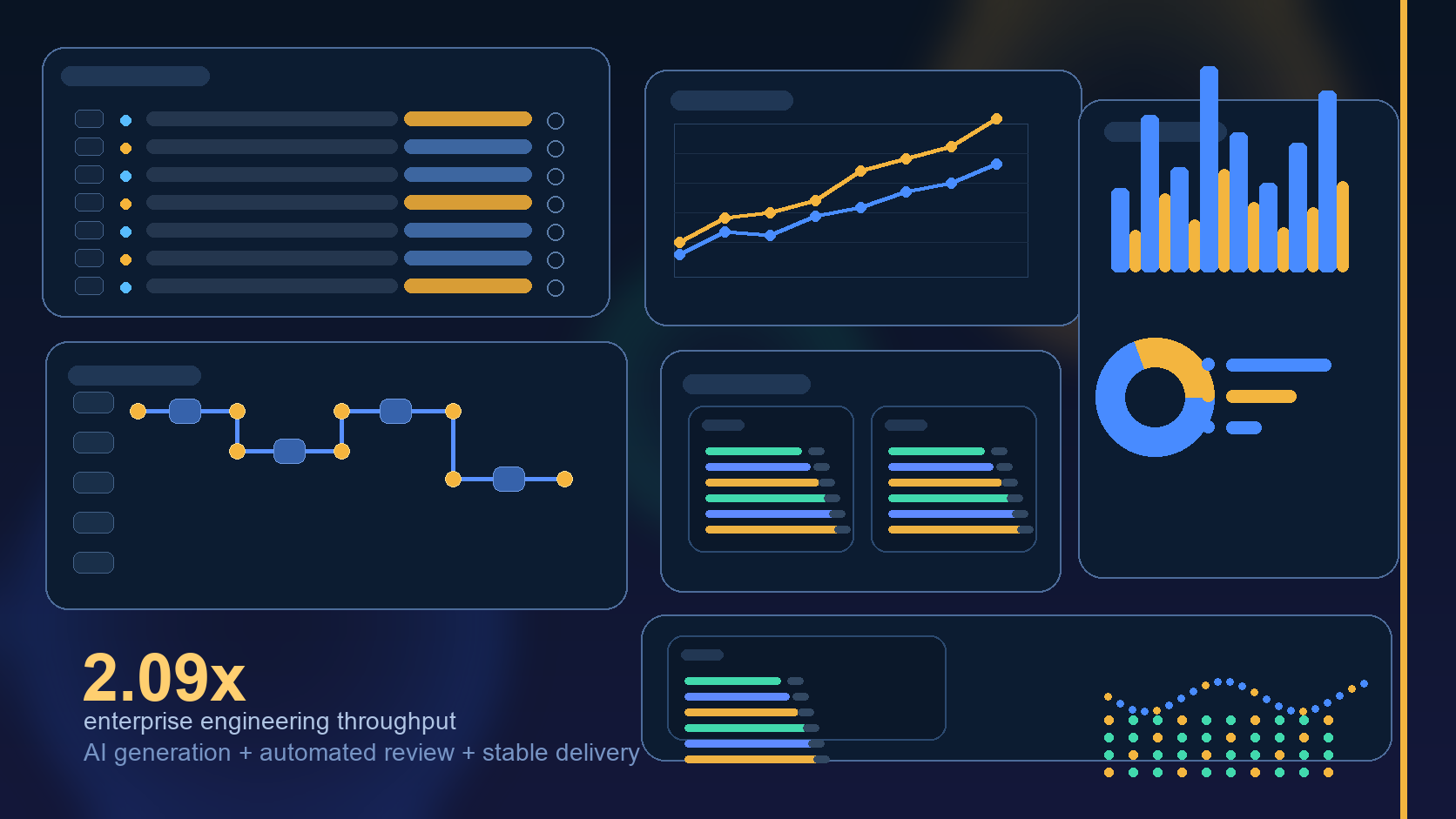
If you want a recent, credible case where AI is being used successfully in a core business workflow, software engineering just produced one of the clearest examples of 2026. A paper submitted on July 2, 2026, titled AI Writes Faster Than Humans Can Review: A Longitudinal Study of an Enterprise 2x Mandate, tracked 802 developers and 196,212 pull requests from January 2024 through April 2026. The headline result is hard to ignore: per-developer throughput reached 2.09x the pre-mandate baseline by April 2026.
That matters because most AI productivity claims in engineering still rely on surveys, short experiments, or internal anecdotes. This study is more commercially useful. It follows one company over time, measures actual merged pull requests rather than self-reported sentiment, and pairs the output gain with a second operational fact that executives care about: merge and revert rates held steady even while reviewer load roughly doubled and automated review overtook human review.
The company is unnamed, so this is not a glossy vendor case study tied to a public brand. But the evidence is still credible enough to matter. It shows what successful AI adoption can look like when leadership sets a clear operating target, developers actually increase usage over time, and the organization redesigns surrounding workflows instead of dropping a coding assistant into the old system and hoping for magic.
The strongest engineering AI cases in 2026 are not about code autocomplete alone. They are about changing the throughput ceiling of the whole delivery system.
What The Study Actually Found
The paper describes a mid-sized, AI-forward company that committed in mid-2025 to doubling merged pull requests per engineer. By April 2026, that target had effectively been reached. The authors do not say management pressure alone caused the result. Their analysis instead points to an adoption-and-use channel: developers who used AI more heavily captured more of the gain, and the benefit grew with accumulated usage over time.
That distinction is important for business leaders. A mandate by itself is not the business case. The real case is that once developers incorporated AI deeply enough into daily work, output changed materially. The gain was also broadly shared across seniority levels, which makes the result more interesting than the usual story where only elite early adopters benefit.
The study also reports that gains were concentrated in newer code. That matches what many engineering organizations are seeing in practice. AI tends to perform better where context is cleaner, interfaces are still changing, and the work is less entangled with years of legacy constraints. That does not weaken the case. It clarifies where the first durable returns are likely to appear.
Just as important, the paper says the organization had to rebalance review work around the extra code volume. Per-reviewer load roughly doubled, and automated review overtook human review. In other words, code generation scaled faster than traditional review capacity. The company did not solve that by pretending human bottlenecks no longer mattered. It solved it by changing the review layer itself.
Why This Looks Like A Real Business Case
First, the metric is tied to output that matters commercially. Merged pull requests are not perfect, but they are much closer to shipping activity than vanity metrics like prompt count or weekly active AI users. When throughput nearly doubles over a long period, engineering leaders can connect that to release cadence, backlog burn-down, and how much product work the same team can absorb.
Second, the timeline matters. Many AI pilots produce a temporary spike because teams are curious, management is watching, or only a handful of strong use cases are being measured. This study is valuable because it follows the company over months, not days. The core result is not a launch-week bump. It is a cumulative shift that grew with repeated usage.
Third, quality did not obviously collapse. The abstract says merge and revert rates held steady. That does not prove the code quality story is perfect, but it does address the most basic executive concern: if output doubles, are we simply manufacturing more defects faster? The evidence here suggests the organization found a way to expand throughput without a visible break in those downstream signals.
Fourth, the study exposes the hidden cost center that many AI rollout decks miss. If AI writes faster than humans can review, then the real constraint moves downstream. That is exactly what happened here. Automated review became part of the answer. For businesses, that is a useful lesson: the ROI of coding AI depends not only on generation, but on whether testing, review, and merge governance can scale with it.
What Other Businesses Should Copy
Most firms will not run an explicit “2x” mandate, but several parts of this case travel well.
- Set a workflow-level outcome. The useful target here was throughput, not “try the tool and see what happens.”
- Expect gains to compound with repeated use. The paper points to cumulative adoption, not one-time exposure, as the mechanism behind the result.
- Modernize review and governance at the same time. If generation speeds up and review does not, the bottleneck just moves.
- Start where context is fresher. Newer code appears to be a better fit for early AI leverage than the oldest, messiest parts of the stack.
- Measure operational outputs that leadership already trusts. Throughput, merge flow, revert rates, and reviewer load are more useful than broad “productivity” sentiment.
The deeper lesson is that successful AI adoption in engineering is not only about individual developers working faster. It is about the organization deciding which parts of the delivery system will change with the tool. In this case, coding, review, and managerial expectations all moved together. That is why the case is stronger than a typical copilot trial.
The Caveats
This is still not a randomized enterprise rollout. The authors explicitly say adoption and usage intensity were not randomly assigned, so the evidence strongly implicates AI usage without claiming exact causal precision. That is an important distinction, especially for executives who want to convert every improvement into a clean ROI formula.
The company is also unnamed. That limits how much outside context we can gather about its architecture, delivery model, or business pressure. A startup with greenfield code and a strong AI culture will not look the same as a bank running decades-old systems.
There is also a useful contrast with prior research. A July 2025 randomized trial on experienced open-source developers found that early-2025 AI tools actually slowed completion time by 19% in mature projects. Taken together, the two studies suggest the business case depends heavily on context: company workflows, code freshness, adoption depth, and the surrounding review system all matter.
The Business Takeaway
The clearest takeaway from this July 2, 2026 study is that engineering AI becomes commercially credible when businesses treat it as a delivery-system redesign, not a personal productivity perk. The company did not just buy a coding tool. It paired AI usage with a concrete throughput goal, let gains compound through repeated use, and changed code review operations so the rest of the pipeline could keep up.
If you are evaluating AI for your own engineering organization, the right question is not whether developers can generate more code. The better question is whether your delivery system can translate that extra code into trustworthy merged output. When throughput rises, review, testing, and governance have to scale too. In this case, that is exactly where the business case became real.
Sources & Further Reading
- arXiv: AI Writes Faster Than Humans Can Review: A Longitudinal Study of an Enterprise 2x Mandate — July 2, 2026 primary paper covering 802 developers, 196,212 pull requests, the 2.09x throughput result, reviewer-load changes, and the authors' caution on non-random adoption
- PDF: AI Writes Faster Than Humans Can Review — Full paper for the longitudinal design, difference-in-differences analysis, and the finding that automated review overtook human review while merge and revert rates held steady
- arXiv: Measuring the Impact of Early-2025 AI on Experienced Open-Source Developer Productivity — Prior contrasting study showing a 19% slowdown in mature open-source projects, useful for framing why workflow context and codebase type matter