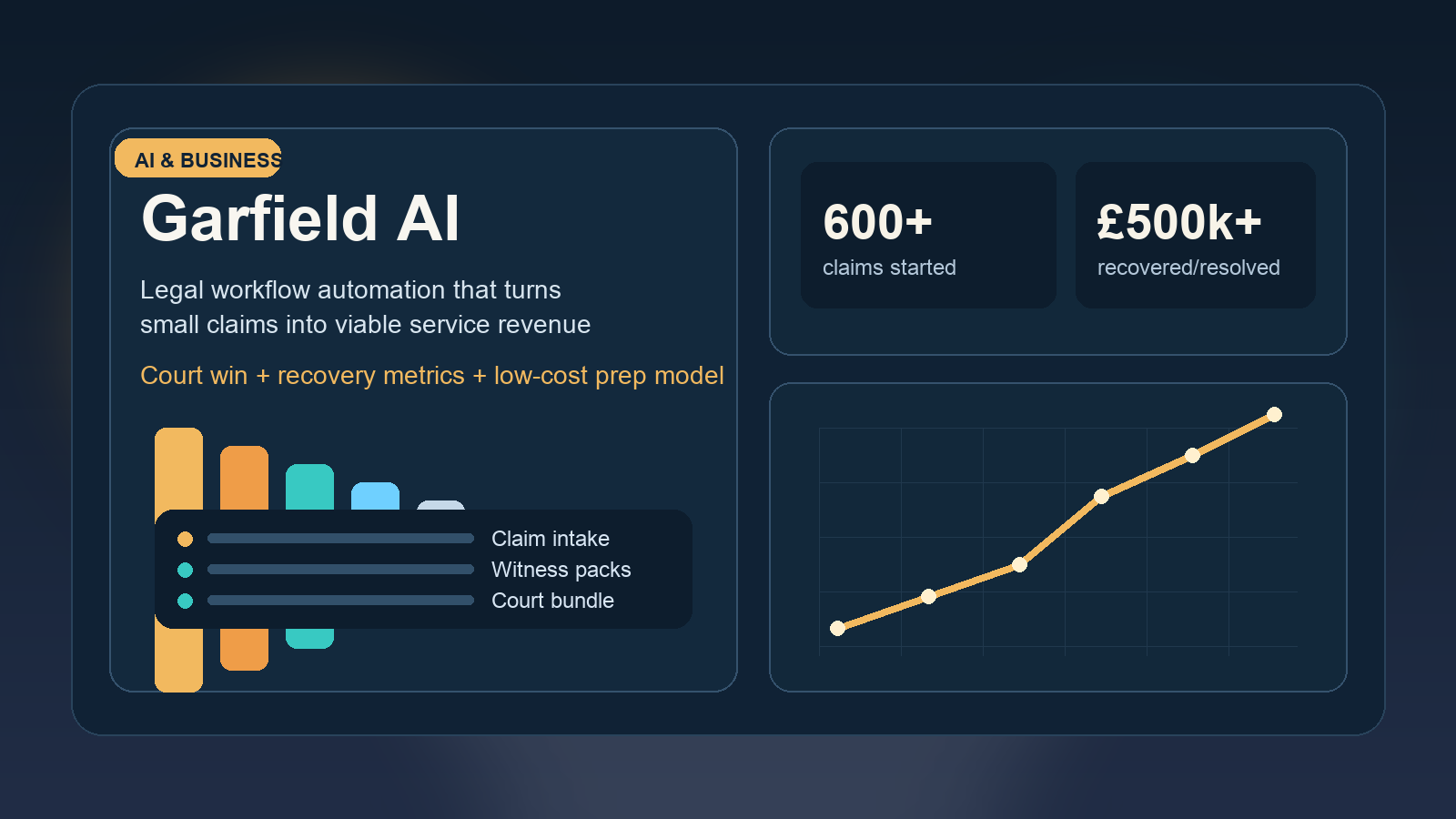
A recent legal-services case gives one of the clearest commercial signals yet for AI adoption in structured professional work. On June 22, 2026, Garfield AI said it had helped a freelancer win a £7,000 debt claim in Wandsworth County Court after preparing the pretrial legal work with its regulated AI system. The claimant reportedly spent about £400 using Garfield to pursue the case, while a human barrister handled the courtroom advocacy. On its own, one case would not be enough to call this a business case. What makes it credible is the surrounding operating data: Garfield says it has already seen more than 600 claims started on the platform and has recovered or resolved more than £500,000 for users in just over a year.
That is commercially important because small debt recovery is exactly the kind of workflow that traditional legal services often underserve. The claims are real, but the economics are broken. For many freelancers and small businesses, the likely recovery is too small to justify paying a solicitor by the hour, especially when the process involves letters, filing, witness statements, bundles, and procedural follow-up. Garfield's model appears to work because it does not try to automate the whole justice system. It compresses the structured preparation work enough to make more claims economically actionable.
The strongest near-term AI business cases often come from fixing workflows that were previously too expensive to serve, not from replacing the highest-value human judgment.
What Actually Happened
According to Garfield's June 22 press note, the company helped claimant Tamires Camal Taquidir pursue unpaid HR-related fees against a hospitality business. Garfield handled the pre-action correspondence, helped prepare and issue court proceedings, and supported the claimant through document production, trial bundles, and the preparation of four witness statements. The case then went to a three-hour trial on May 14, 2026, where a human barrister argued on the claimant's behalf. The court awarded the claimant £7,000 and dismissed the counterclaim.
The Guardian independently reported the same case on June 22 and described Garfield as the first AI law firm of its kind to help win a case in an English court. Business Insider added another useful layer in its late-June reporting: Garfield said the court-win publicity drove a 1,000% increase in site traffic. That does not prove long-term revenue on its own, but it does suggest the market has been waiting for a trust signal strong enough to convert curiosity into demand.
Why This Is A Real AI Business Case
The case matters because it shows AI can make a low-margin professional service viable by changing the cost structure. Garfield's own website says the product starts with debt-recovery correspondence priced from £2 and formal letter-before-action work from £7.50. It also markets itself as 20x faster and 10x cheaper than the traditional alternative. Those are vendor claims, so they should be treated carefully. Still, the core logic is sound. If AI reliably handles the repetitive intake, drafting, and document assembly work, then the provider can serve claims that conventional firms often cannot profitably touch.
This is where the business takeaway becomes broader than legal tech. Many AI pitches still focus on saving time for existing high-value workers. Garfield shows another route to value: opening a market segment that was economically unattractive before automation. That is often a stronger commercial wedge. Instead of asking whether AI can replace a solicitor, the better question is whether AI can make a previously uneconomic service deliverable at acceptable quality and risk.
The case also has an operational design lesson. Garfield did not claim that AI should argue the case in court. It used AI for the structured, document-heavy, repeatable parts of the workflow and kept human advocacy in the loop for the adversarial hearing. That boundary matters. It is one reason the story reads as credible rather than reckless.
Why The Volume Metrics Matter More Than The Headline Win
The media-first angle is the courtroom win, but the more durable signal is the combination of 600-plus claims and £500,000-plus recovered or resolved. Those numbers suggest Garfield is not just a publicity stunt or one-off experiment. They indicate repeated use across many small claims, which is exactly what you want to see when judging whether AI has become part of an operating model.
Garfield's homepage adds further clues about why the workflow scales. The system integrates with accounting tools, supports bulk claims, and positions debt recovery as a pipeline rather than a bespoke legal project. That matters because AI tends to create the most leverage where work is repetitive, document-rich, and process-bound. Once invoices, contracts, deadlines, and standard legal steps become structured inputs, the economics start to change fast.
There is still an evidence caveat. Garfield is both the operating company and one of the primary sources for the numbers. That means leaders should read this as a strong directional case, not a neutral audited ROI study. Even so, the case is more concrete than most AI marketing because it anchors the story in one court result, one explicit price comparison, and one live workflow with real claim volumes.
What Other Businesses Should Copy
The most transferable lesson is not "build an AI law firm." It is to find structured service work where the economics break before the need disappears.
- Target workflows that are real but underserved. Garfield appears to win where customer need exists but traditional delivery costs are too high.
- Automate the preparation layer first. Intake, drafting, document assembly, and process navigation are often better AI targets than final judgment calls.
- Keep human control at the risk boundary. Garfield's model is strongest where AI prepares and humans own the consequential live decision points.
- Use pricing to unlock dormant demand. A service that starts at a few pounds creates a different adoption curve than one that starts with hourly legal fees.
- Measure repeat usage, not just one flagship outcome. Claim count and recovered value tell you more about product-market fit than one viral case.
Why This Matters Beyond Legal Services
Garfield's model should catch the attention of any business selling expert services into a fragmented market. Insurance administration, compliance filing, collections, contract ops, permit handling, and regulated customer support all share the same pattern: too much paperwork for customers to do alone, but too little revenue to justify full-service expert delivery. AI can be commercially powerful in those environments because it lowers the labor floor required to serve the work at all.
That is a more interesting business case than simple labor substitution. When AI lowers transaction costs enough, it can pull entirely new demand into the market. In Garfield's case, the demand is people and small businesses that previously might have written off valid claims. In another industry, it could be low-value audits, small-account onboarding, or compliance tasks that humans ignored because the unit economics were poor.
The Business Takeaway
Garfield AI's June 2026 court win is best read as proof that AI adoption in legal services becomes commercially credible when it is aimed at structured preparation work, radically lower delivery cost, and clear human oversight. The company says it has now processed more than 600 claims, recovered or resolved more than £500,000, and helped users pursue matters that conventional legal pricing often makes uneconomic.
That is the Havlek-style lesson. If you want a strong AI business case, do not start by asking where AI can replace experts outright. Start by asking where expert workflows are so document-heavy and cost-sensitive that they are currently under-served. If AI can compress the preparation layer while humans keep control over the highest-risk moments, the result is not just efficiency. It is new revenue from work the market could not profitably serve before.
Sources & Further Reading
- Garfield AI: AI Lawyer in Historic First Court Trial Win — Published June 22, 2026; primary source for the May 14, 2026 trial date, the £7,000 award, the roughly £400 claimant cost, the four witness statements, and Garfield's 600-plus claims / £500,000-plus recovered-or-resolved figures
- Garfield AI homepage — Accessed July 12, 2026; source for claims up to £10,000, pricing from £2 and £7.50, accounting-software integrations, and Garfield's current 20x faster / 10x cheaper positioning
- The Guardian: HR consultant wins English court case using AI lawyer in apparent legal first — Published June 22, 2026; independent reporting on the Wandsworth County Court win and Garfield's regulated-law-firm status
- Business Insider: Score 1 for AI. Law firm staffed by bots wins a case in an English court. — Published June 27, 2026; source for the reported 1,000% traffic jump after the court-win publicity and additional context on Garfield's market demand