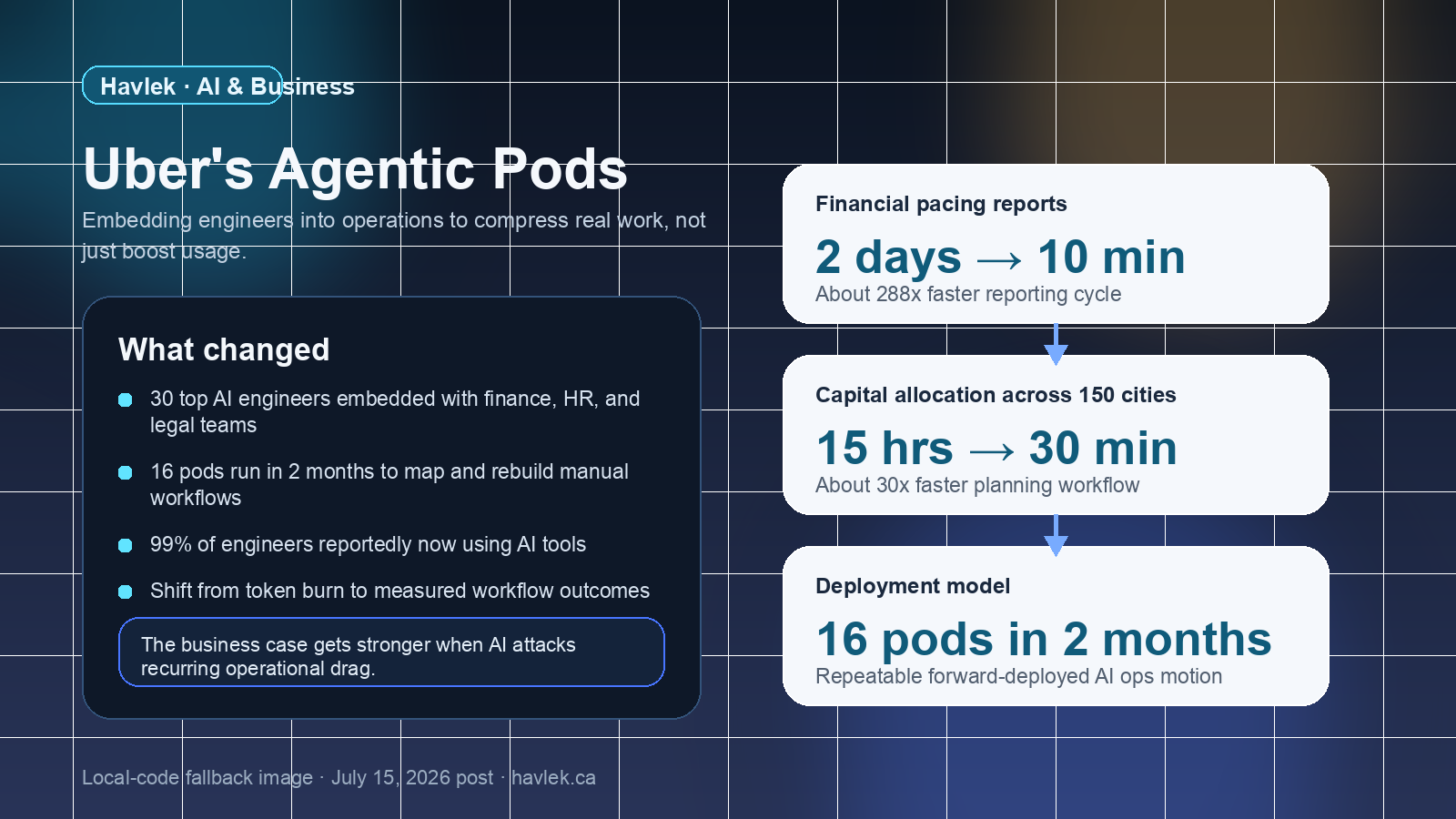
A fresh July 9, 2026 report from Business Insider offers one of the more credible AI adoption cases of the month because it includes a lesson many executives are only now learning: raw AI usage is not the business case. Workflow redesign is. According to the report, Uber's CTO Praveen Neppalli Naga embedded 30 highly AI-proficient engineers with finance, HR, and legal teams for two-week sprints, observed how the work was actually done, and used that proximity to build internal AI agents around messy, multi-system operating tasks.
The early results are strong enough to matter. Uber says one financial pacing report that previously took two days can now be produced in about 10 minutes. A separate capital allocation workflow across 150 cities reportedly dropped from 15 hours to 30 minutes. Naga also said Uber had already run 16 Agentic Pods in two months, and subsequent reporting on July 10, 2026 said 99% of Uber engineers were now using AI tools in some form.
That combination makes this more than a hype story. It is a useful business case because the numbers are tied to recognizable operating work: recurring reports, cross-city planning, and manual coordination across internal systems. This is the kind of overhead that compounds quietly inside large organizations. If AI can compress that work reliably, the payoff is not theoretical.
The strongest AI business cases in 2026 are moving away from token consumption and toward measured time compression inside expensive workflows.
What Actually Changed
The important part of Uber's approach is not simply that it used agents. It is that the company stopped trying to automate from a distance. Business Insider reports that engineers were physically or functionally embedded with nontechnical teams to see how work happened in practice rather than how it looked in documentation or process diagrams. That matters because high-friction back-office work often lives in undocumented handoffs, spreadsheet habits, approvals, and judgment calls spread across several tools.
In other words, Uber did not treat AI deployment as a license rollout. It treated it as a forward-deployed operating exercise. Engineers studied the workflow, identified which steps were repetitive enough to automate, and then built agents around those exact bottlenecks. The result was not a generic chatbot for employees. It was a set of narrow systems aimed at compressing specific pieces of operational drag.
That distinction is central. Many enterprises still hope AI will produce value by being made broadly available, then left for employees to figure out. Uber's recent case points in the opposite direction. The company appears to be pushing its best AI talent into the business functions where work is already costly, manual, and hard to scale.
Why This Looks Like A Real Business Case
There is a useful contrast here with Uber's own earlier comments from May 26, 2026. In an interview covered by The Verge, Uber president and COO Andrew Macdonald said the company had already exhausted its annual AI budget four months into the year and was struggling to connect exploding token consumption with more useful consumer features. A separate report on May 27, 2026 said Macdonald estimated AI tools had lifted internal productivity by around 25%, but even then the business-case link was still blurry.
That context is exactly why the July Agentic Pods story matters. It suggests Uber may have found a more commercially credible path: stop treating AI intensity as a vanity metric and start applying it to recurring operational work with clear before-and-after timings. A report shrinking from two days to ten minutes is a stronger business case than almost any abstract "our teams are using AI more" update.
There is still an important caveat. These are company-reported or report-attributed outcomes, not peer-reviewed measurements. But even with that caution, the story is more useful than most because the workflows are concrete, the time savings are large, and the organizational method is transferable. The pattern matters even if every number shifts a bit under deeper audit.
What Uber Seems To Have Figured Out
- Embed builders where the work actually happens. Engineers close to finance, HR, and legal teams can model the real workflow rather than the official diagram.
- Prioritize multi-system manual work. The best AI gains often come from tasks that require repetitive cross-checking across several tools, not from the most glamorous use cases.
- Measure time compression directly. Two days to 10 minutes and 15 hours to 30 minutes are business metrics executives can reason about immediately.
- Use broad adoption as an input, not the proof. High engineering usage only matters if it feeds into outcomes that improve the economics of the operation.
- Scale through a repeatable program. Sixteen pods in two months implies Uber is productizing a deployment method rather than celebrating one isolated win.
What Other Businesses Should Notice
At Havlek, the most transferable lesson is not specific to Uber or transportation. It is that many AI programs fail because they start too high in the stack. Leadership buys tools, creates dashboards, and waits for adoption. But the business case only becomes visible when someone gets into the weeds of how work is assembled. The hidden value is often in recurring internal processes that are too boring to get product attention and too fragmented to justify conventional automation spend.
Finance reporting, headcount planning, policy review, procurement approvals, branch operations, field scheduling, and compliance prep often share the same structure: information is spread across systems, the workflow is repetitive but not trivial, and skilled people spend too much time stitching context together. That is exactly the sort of work that can benefit from agent-style assistance if the process is observed carefully first.
The second lesson is governance. Uber's earlier comments about AI budget pressure are a reminder that more usage does not automatically mean more value. The July case works because it reframes AI as a targeted operating investment. Instead of maximizing tokens everywhere, Uber seems to be putting AI against high-friction workflows where the output can be measured in hours returned to the business.
Why This Matters In 2026
As of mid-July 2026, the market is flooded with AI adoption stories. Most are not very useful. They either describe enthusiasm without economics or they offer productivity claims without naming the workflow. Uber's Agentic Pods rollout is more instructive because it sits at the uncomfortable middle point companies are now facing. AI is expensive. Blanket experimentation is easy. Proving value is hard.
The companies that win this phase will probably look less like broad AI consumers and more like disciplined workflow redesigners. They will move top builders into expensive internal bottlenecks, instrument the baseline, and only scale once the time savings are obvious. Uber's July case suggests that shift may already be underway.
The Business Takeaway
Uber's July 2026 Agentic Pods story is a strong current business case for AI adoption because it replaces vague usage metrics with operational outcomes. Embedding 30 AI-proficient engineers inside business teams helped one reporting workflow fall from two days to 10 minutes, cut a city-capital allocation process from 15 hours to 30 minutes, and scale into 16 deployment pods in two months.
The Havlek-style takeaway is simple. If you want a credible AI business case, do not start with "where can everyone use AI more?" Start with "which recurring workflows waste the most skilled time, and can we prove compression there first?" That is where adoption stops being theater and starts becoming operating leverage.
Sources & Further Reading
- Business Insider: Uber's CTO embedded its top AI engineers in HR, finance, and legal, and found better ways to build — Published July 9, 2026; primary source for the Agentic Pods model, the 30 embedded engineers, the 16 pods in two months, the two-days-to-10-minutes reporting workflow, and the 15-hours-to-30-minutes capital allocation example
- Times of India: Uber CTO says 99% of engineers now use AI tools — Published July 10, 2026; secondary source for Naga's updated adoption framing and the 99% engineering-usage figure
- The Verge: Uber president says AI spending is getting harder to justify — Published May 26, 2026; source for the earlier budget-pressure context and the shift away from treating token consumption as a sufficient metric
- Times of India: Uber COO says AI lifted internal productivity by about 25% — Published May 27, 2026; secondary source for Macdonald's estimate of internal productivity gains and the gap between internal speed and externally visible business value