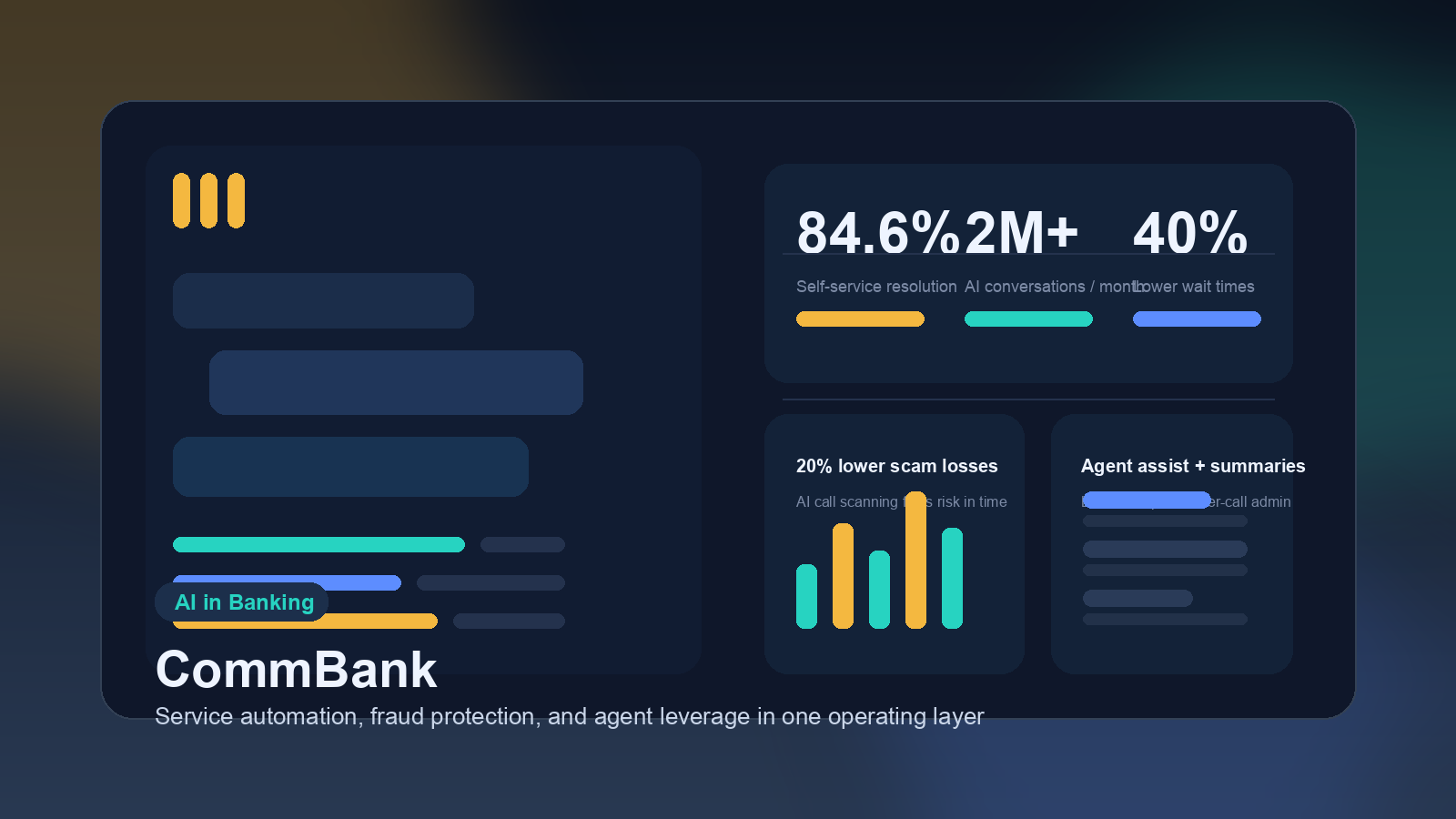
One of the most commercially credible AI stories in banking right now comes from Commonwealth Bank of Australia. On July 9, 2026, Microsoft published a detailed account of how CommBank and Microsoft have been co-engineering AI tools across customer service. The headline metrics are unusually concrete. CommBank says its customer-facing AI now handles more than 2 million conversations per month, resolves 84.6% of messaging contacts end to end without human intervention, and covers over 700 chatbot topics. Those are not vanity numbers. In a service business that fields around 50,000 customer phone calls per day, they point to direct operating leverage.
The story becomes stronger when paired with CommBank's own disclosures from June 9, 2026 and July 14, 2026. The bank has committed A$140 million to improve its customer experience and says that investment is already helping lower call wait times by up to 40%. In a separate July 14 update, CommBank said AI-powered call-scanning has contributed to a 20% reduction in customer scam losses since the capability launched in September 2024. Put those figures together and the case is no longer just about a chatbot answering routine questions. It is about AI reshaping the economics of service, risk, and trust inside a major retail bank.
The best enterprise AI cases do not automate one touchpoint. They compress the whole path from customer intent to secure resolution.
Why This Case Stands Out
Banking is a difficult environment for AI adoption. Service workflows are complex, customer emotions run high, regulation is strict, and every mistake carries reputational risk. That is exactly why CommBank matters. If AI can produce measurable gains inside a tightly governed bank, the deployment model deserves attention.
What makes the case compelling is that CommBank is not optimizing one narrow metric in isolation. Microsoft describes a broader service stack that includes virtual assistants, agent-assist tools, call summarization, intelligent routing, and governance processes shared across the bank and Microsoft's engineering teams. CommBank's customer-service AI is not operating alone. It sits inside a wider operating model that decides when to resolve, when to escalate, how to surface knowledge to staff, and how to feed insights back into future journeys.
That distinction matters. Many AI pilots in financial services look promising because they reduce handling time for one channel or one FAQ set. But the business impact stays limited if customers still get pushed into phone queues, if human agents must restart the conversation from scratch, or if fraud and compliance systems remain disconnected from support. CommBank appears to be solving for the full journey rather than the isolated task.
Where The Operating Value Shows Up
The first layer of value is obvious: messaging containment. An 84.6% end-to-end self-service resolution rate means most chat contacts are no longer consuming human-agent capacity. At CommBank's volume, that does not simply reduce labor pressure. It also changes customer expectations about response speed and availability. If the bank can keep a high share of contacts in self-service while preserving customer trust, it buys back time for specialists to focus on higher-complexity work.
The second layer is phone-call deflection and faster queue movement. CommBank says roughly two-thirds of the most common support reasons can now be handled either through the CommBank app or through its chatbot Ceba. That matters because voice support is usually the most expensive service channel in banking. CommBank's June 2026 update says call wait times have already improved by up to 40%. The logic is straightforward: when simpler needs are resolved earlier, scarce human attention is reserved for difficult cases where it is worth paying for empathy and judgment.
The third layer is employee leverage. Microsoft's write-up says CommBank is using agent-assist tooling to retrieve relevant knowledge faster and reduce manual after-call administration through summarization. That is a classic but important move. Banking service work is often constrained not by raw effort but by information friction: looking up policy, verifying context, repeating notes, and moving data between systems. AI does not have to replace the banker to create value. It only needs to shorten the time between question, context, and action.
The fourth layer is risk reduction. CommBank's July 14 announcement focuses on AI-powered call monitoring that scans conversations in near real time for scam indicators and supports intervention before losses escalate. The bank says this has helped cut customer scam losses by 20% since launch. That is strategically important because it widens the frame of the AI business case. CommBank is not using AI only to lower service costs. It is also using AI to protect customers and reduce a form of loss that directly affects trust, remediation costs, and brand equity.
Why This Matters In July 2026
This case lands at the right moment because many banks are still stuck between experimentation and scaled adoption. They have chatbots, copilots, and fraud models, but those systems often sit in separate lanes with separate budgets and different accountability structures. CommBank's recent disclosures suggest a more mature posture: one coordinated AI program tied to customer experience, service operations, and scam prevention.
There is also governance depth behind the rollout. Microsoft's July 9 article describes joint co-engineering, evaluation loops, and deployment discipline rather than a one-off software install. CommBank's own public updates reinforce that point. The bank is investing real capital, not just experimentation budgets, and it is grounding the AI story in measurable service and protection outcomes. That combination matters more than abstract claims about transformation.
For operators, the strongest signal may be the bank's willingness to treat AI as infrastructure for the service layer. A tool that processes 2 million monthly conversations, supports thousands of service interactions each day, and feeds into voice and fraud workflows is no longer a pilot. It is part of the bank's operating fabric. That is when AI spending starts to look like durable capability instead of discretionary innovation theater.
What Other Businesses Should Copy
- Target the service system, not a single channel. CommBank is connecting chat, app self-service, voice operations, and fraud intervention rather than treating each surface separately.
- Use containment metrics only when they connect to customer outcomes. The 84.6% resolution rate matters because it also links to lower queues and better use of specialist staff.
- Let AI absorb information friction for humans. Agent-assist and summarization can create real value even when final decisions remain human.
- Include risk workflows in the ROI equation. A 20% reduction in scam losses shows AI can protect revenue and trust, not just cut support costs.
- Fund adoption like infrastructure. CommBank's A$140 million customer-experience investment is a reminder that serious AI rollouts need operating-model commitment, not just software licenses.
The Havlek Takeaway
CommBank offers a strong 2026 business case for AI adoption because it shows what happens when AI is embedded across a real customer-service economy. Messaging automation, phone containment, agent assistance, and scam detection are all valuable on their own. But the business impact becomes more meaningful when they reinforce each other inside one governed service architecture.
The broader lesson is that enterprise AI adoption works best where demand is repetitive, service stakes are high, and the cost of delay is obvious. Banking fits that pattern, but so do insurance, telecom, healthcare administration, utilities, and large-scale ecommerce support. The commercial win does not come from launching a smarter chatbot. It comes from redesigning the path from inquiry to safe resolution.
That is why CommBank's July 2026 case matters beyond banking. It suggests the next wave of successful AI adoption will belong to organizations that connect customer channels, employee context, and risk controls into one operating layer. When AI helps the whole service system move faster and safer, the economics finally get hard to ignore.
Sources & Further Reading
- Microsoft Source Asia: How Commonwealth Bank and Microsoft are reimagining the future of customer service — Published July 9, 2026; primary source for the 2 million monthly AI conversations, 84.6% end-to-end self-service resolution rate, 700+ chatbot topics, 50,000 daily calls, and the co-engineering model across virtual assistant and agent-assist workflows
- CommBank Newsroom: CommBank invests A$140 million to improve customer experience — Published June 9, 2026; source for the A$140 million customer-experience investment, the statement that two-thirds of common call reasons can now be handled digitally, and wait-time reductions of up to 40%
- CommBank Newsroom: Calls-scanning AI helps strengthen customer protection — Published July 14, 2026; source for the AI-powered call scanning capability and the reported 20% reduction in scam losses since launch in September 2024