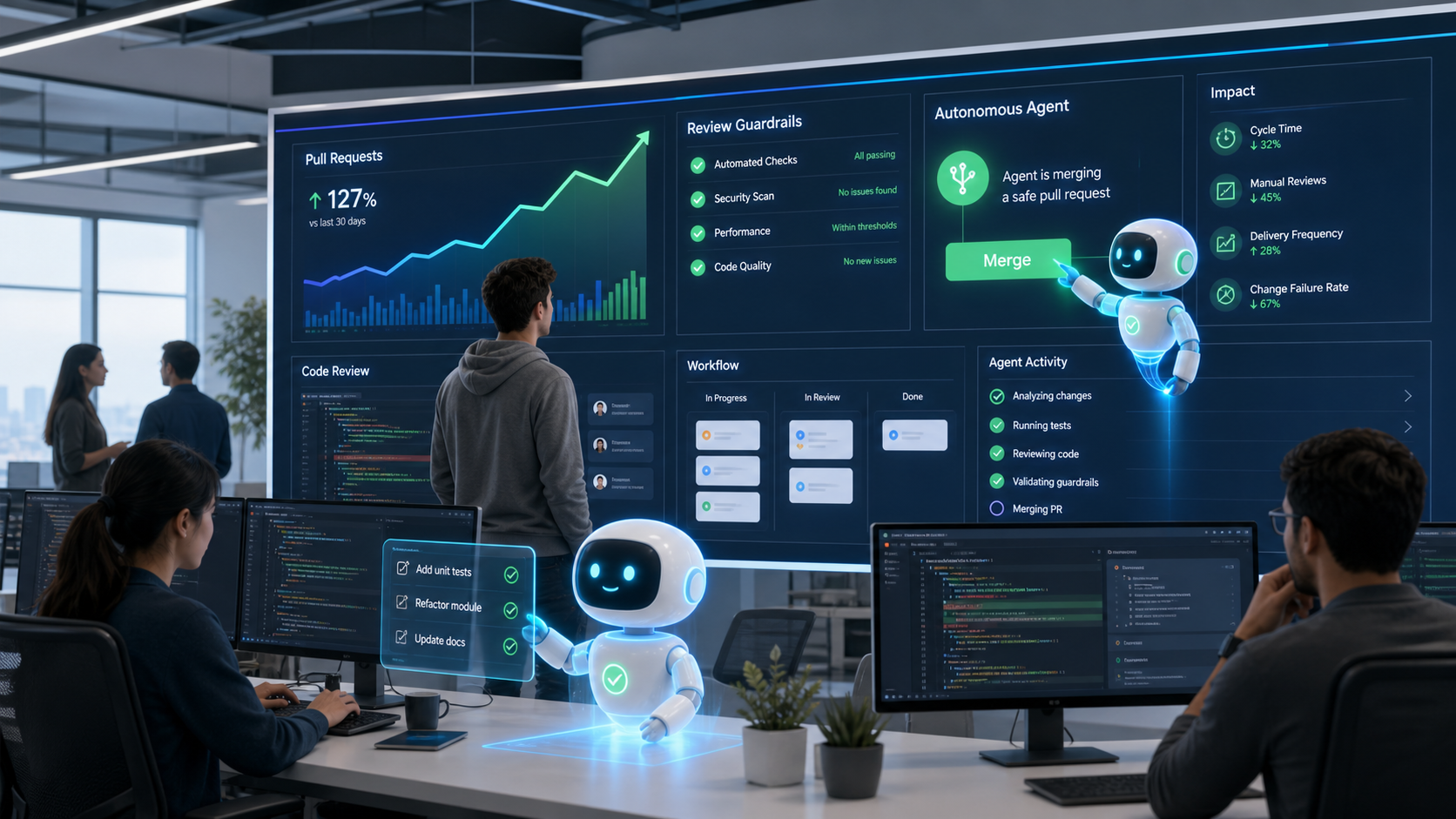
One of the clearest recent business cases for AI adoption in software engineering landed on July 22, 2026, when AWS and monday.com published a detailed look at how monday runs production AI agents inside its own engineering system. The headline numbers are strong enough to matter outside the developer-tools bubble: 9 in 10 Builders use AI coding tools every month, per-engineer pull request throughput is up by more than half, and monday's first fully autonomous engineering agent, Morphex, now sees 19 out of 20 PRs merge automatically after passing the same review gates as human contributors.
That mix is what makes the case commercially relevant. This is not a lab demo and it is not a startup building on a blank canvas. monday.com describes a decade-old code base, millions of paying users, hundreds of microservices, and real production expectations. The company is using AI not just to help engineers draft code faster, but to change how work gets assigned, validated, reviewed, and shipped across a live SaaS platform.
The strongest engineering AI cases do not stop at generation. They redesign the path from task to safe production change.
What monday.com Actually Changed
The July 22 AWS post shows monday.com operating across three maturity levels. At the first level, engineers use AI assistants as pair programmers. At the second, teams create reusable skills and sub-agents for repeated work. At the third, agents begin to own delivery end-to-end while humans orchestrate the workflow. Most companies never get beyond the first layer. monday.com appears to be building the second and third layers into daily operations.
That matters because the company did not solve for model access alone. It built a production harness around the models. The architecture routes events from Slack, monday boards, and GitHub into one agent session with shared state, file-based memory, remote sandboxes, PR guardrails, and audit trails. In practice, that means the agent is not a floating chatbot. It is a managed worker with identity, permissions, history, rollback paths, and a place in the same operating system humans already use.
monday.com's own May 6, 2026 investor announcement adds useful context. The company described this as the biggest change in its history, repositioning monday.com as an AI Work Platform where people and agents work side by side across departments. A week later, its product blog said customer-facing agents were now officially available and designed to reduce manual effort while keeping people in control. The July engineering case shows the company applying that same operating idea internally first, where the economics are easier to measure.
Where The Business Value Shows Up
The first gain is adoption at scale. According to the AWS post, monthly use of AI coding tools among monday Builders rose to 90%, up from roughly half a year earlier. That is important because many enterprise AI programs still get stuck between license rollout and habitual use. monday's numbers suggest the tools are close enough to real work that usage has become normal, not performative.
The second gain is throughput. monday says per-engineer PR output increased by more than 50%. For a software business, that is not just a developer metric. More deployable pull requests can mean shorter backlog cycles, faster feature delivery, quicker bug resolution, and more capacity to improve the product without adding headcount at the same rate.
The third gain is review compression. monday's account says the bottleneck moved from code generation to human review by late Q1 2026. That is the correct bottleneck to attack. Many AI engineering programs produce code quickly but still require the same slow review and validation layers, which caps the business impact. monday responded by translating engineering standards into automated guardrails tied to its internal knowledge systems. The post says roughly one in five PRs, across agent- and human-authored work, fails at least one standard check and gets bounced back before merge. That is meaningful because it turns review from a pure human queue into a systemized filter.
The fourth gain is credible autonomy. Morphex reportedly merges 19 of every 20 PRs automatically after passing every gate. Across monday's top PR-generating agents, the company says about three in ten PRs merged, roughly three-quarters of those merged with zero human edits, and the revert rate stayed in the low single digits. Another quarter of agent PRs were stopped by guardrails before reaching a human. That pattern matters more than any single number. It suggests monday is not maximizing autonomy blindly. It is building a system where low-confidence work gets trapped early and higher-confidence work can move faster.
Why This Matters Beyond Software Companies
On the surface, this looks like an engineering story. In reality, it is a broader operating-model story. monday.com is showing that AI becomes more valuable when it is treated as a governed coworker inside the existing workflow, not as a separate productivity toy. Stable identity, task ownership, memory, permissions, and review gates are what let autonomy scale without becoming chaos.
That pattern travels well beyond software. Legal review, procurement approvals, customer operations, sales enablement, and compliance-heavy back-office work all have the same structural problem: too much effort is spent moving tasks between humans, checking whether rules were followed, and reconstructing context after a handoff. The monday case suggests that the real gain from AI is not just faster first drafts. It is fewer expensive handoffs inside a process that still remains observable and reversible.
It also reinforces a broader lesson from recent enterprise AI adoption: the winners are building feedback systems, not just prompts. monday's post is explicit about evals, sandboxing, guardrails, and confidence scores. That is why the case deserves executive attention. The value is not that one agent can code. The value is that the company is learning how to trust AI output selectively, with evidence.
What Other Businesses Should Copy
- Measure workflow adoption, not just license counts. monday's 90% monthly usage figure is stronger than a procurement announcement.
- Attack the next bottleneck after generation. Once AI speeds up draft work, review and compliance become the real constraint.
- Turn standards into automated gates. Guardrails created a scalable filter before human review ever started.
- Keep AI inside existing systems of record. monday boards, GitHub, and Slack remained the shared operating layer rather than creating a disconnected AI sidecar.
- Trust should be graduated, not absolute. Confidence scoring, sandbox checks, and revert data are what make selective autonomy plausible.
The Havlek Takeaway
monday.com's July 22, 2026 case stands out because it shows a more mature pattern of AI adoption in engineering: widespread usage, measurable throughput gains, automated governance, and early signs of selective autonomy that do not depend on removing humans entirely. The company is not claiming perfect agents. It is claiming a better delivery system for imperfect agents, and that is a much more believable source of business value.
The practical lesson for leadership teams is simple: if your AI rollout still lives mostly in chat windows and one-off experiments, you are probably optimizing the least valuable layer of the workflow. The larger returns appear when AI gains identity, memory, review standards, and a defined place in production work. monday.com is showing how that shift can turn engineering AI from a developer convenience into operating leverage.
Sources & Further Reading
- AWS: AI Teammates, how monday.com runs production AI agents on Amazon Bedrock — Published July 22, 2026; primary source for the 90% monthly AI tool adoption, more-than-50% PR throughput increase, 19-in-20 Morphex merge rate, zero-edit merge share, low-single-digit revert rate, and guardrail-based workflow design
- monday.com investor release: from work management platform to AI Work Platform — Published May 6, 2026; official company context on monday.com's shift toward people-and-agents workflows and native agent deployment inside existing governance controls
- monday.com product blog: Welcome to the agentic era at monday.com — Published May 14, 2026; official product context on how monday positions agents as workflow-native teammates focused on efficiency, productivity, and accuracy under human oversight