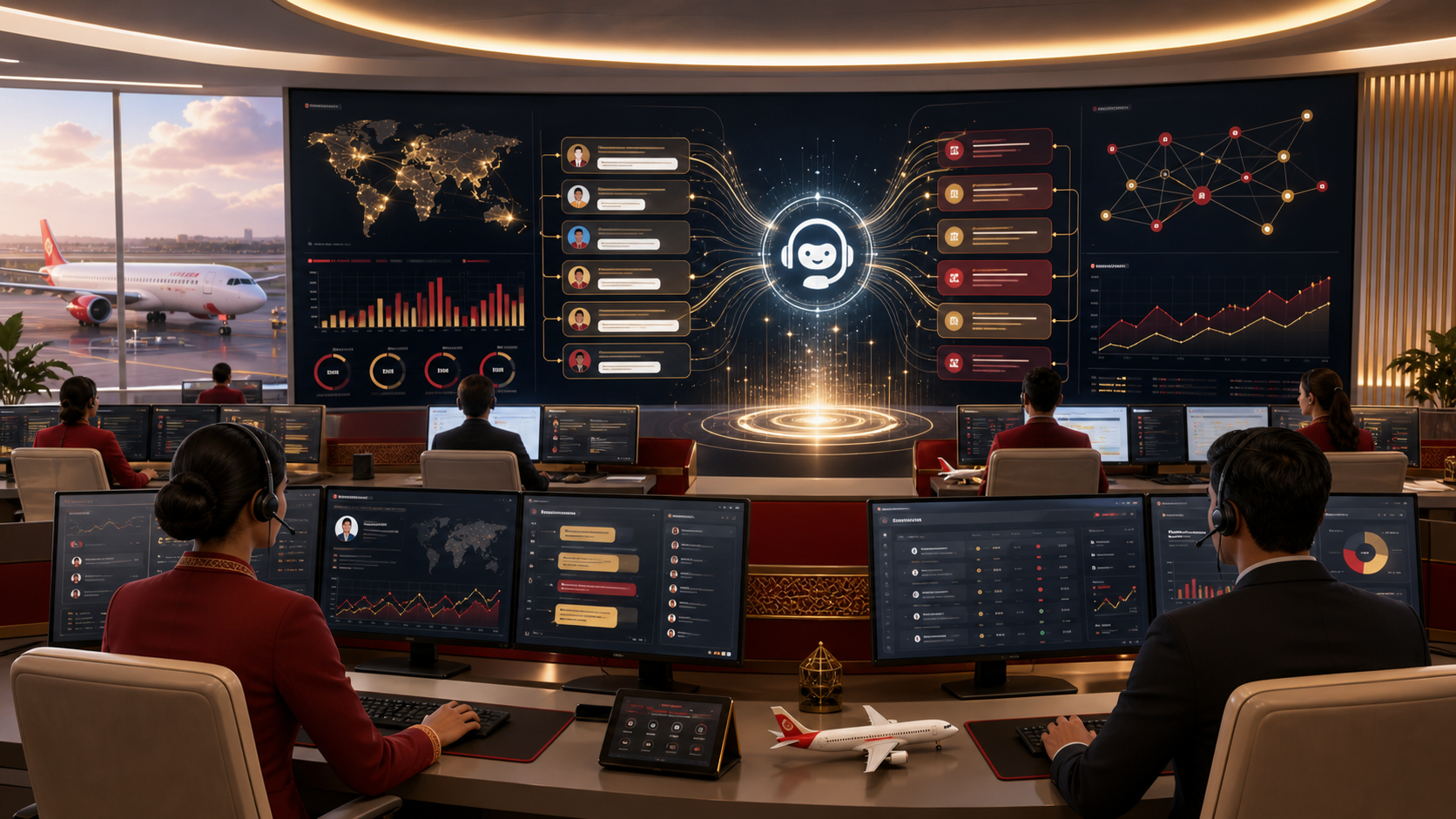
One of the most credible recent AI adoption stories in customer service comes from Air India. In an official Microsoft customer story published on February 11, 2026, and reinforced in a Microsoft commercial business post on April 28, 2026, the airline described what happened after it built and scaled AI.g, its generative AI customer-service agent. The numbers are strong enough to matter outside aviation: about 40,000 customer queries handled per day, more than 13 million conversations resolved since launch, and a 97% success rate.
This case stands out because it is not just a chatbot story. It is a workflow and operating-model story. Air India had millions of inbound questions overwhelming support channels, pushing up costs and slowing response times. Rather than using AI as a thin layer on top of the same process, the airline used it to absorb high-volume routine work at production scale while keeping human agents available for the cases that actually require judgment.
The best AI service cases do not merely deflect tickets. They redesign who handles what, at what speed, and with what customer experience.
What Air India Actually Changed
According to Microsoft's February 2026 customer story, Air India's internal team moved from problem recognition to a viable agentic system in six months. That matters because many enterprise AI programs still get trapped in pilot mode. Air India instead shipped a customer-facing support capability, let it learn from real interactions, and scaled it into a meaningful service layer.
The scope is broad. AI.g handles more than 1,300 different question types, ranging from booking changes and refund requests to baggage information, flight status, loyalty-account help, and self-service re-accommodation. Air India's own support pages also show that AI.g is embedded into multiple channels, including the airline website and WhatsApp, with multilingual support and direct assistance for routine case creation and case-status checks.
That breadth is part of the business value. A narrow demo can look impressive without changing economics. Air India instead targeted the repetitive support volume that creates wait times, service inconsistency, and staffing pressure. When AI covers common requests across core support journeys, it reduces the amount of low-value traffic that would otherwise consume trained agents.
Where The Business Value Shows Up
The first gain is high-volume containment. Microsoft's reporting says AI.g currently handles about 40,000 daily queries and has resolved more than 13 million conversations with a 97% success rate. In practical terms, that means only a small minority of interactions need escalation. For a consumer-facing business with volatile demand and round-the-clock support expectations, that is a meaningful operating lever.
The second gain is cost reduction with service improvement. Air India's leadership says the rollout has already saved millions of dollars. That claim matters because it is paired with an outcome customers can feel: faster answers and less waiting. This is the pattern executives should look for. AI becomes commercially credible when cost efficiency and customer responsiveness improve together, instead of one being traded off against the other.
The third gain is human labor reallocation. Air India's Chief Digital and Technology Officer says contact-center staff can now spend more time on "more value-added" work and on complex cases requiring nuanced problem-solving. That is a more durable AI thesis than simple headcount reduction. In many service organizations, the expensive failure mode is not too few agents in total, but too many skilled agents spending their day on repetitive requests that should never have reached them.
The fourth gain is customer choice. Microsoft's customer story notes that about half of Air India's customers now choose AI.g as their first preference, while the rest still prefer a person. That is strategically useful. It suggests Air India did not need to force full automation to capture value. The airline built a service model where AI becomes the first lane for many travelers, while human support remains available and credible for the rest.
Why This Case Matters Beyond Airlines
Air India is in travel, but the underlying pattern is common across large service organizations. Telecoms, banks, insurers, marketplaces, logistics networks, and healthcare administrators all deal with a similar mix of high-frequency routine questions, channel fragmentation, case-status chasing, and expensive human escalation.
The key lesson is that AI service ROI usually appears in bundles of workflows, not in isolated FAQ experiences. AI.g is useful because it connects multiple support jobs: answering common questions, guiding customers through self-service, helping with case creation, checking case status, and handing off the right residual work to people. That makes the unit economics better and the customer journey less fragmented.
There is also an execution lesson here. Air India did not wait for a perfect end-state platform. It launched a viable system, improved it through observed interactions, and expanded what it could handle. For many companies, that is the right way to think about service AI adoption: ship inside a governed scope, learn from real demand, then expand into adjacent workflows where the support burden is already obvious.
What Other Businesses Should Copy
- Target the highest-volume repetitive support queues first. Booking changes, refunds, status checks, and policy questions are better starting points than edge cases.
- Measure containment and escalation together. A 97% success rate matters because it shows what still requires humans, not just what AI answered once.
- Keep customer choice in the design. AI adoption scales faster when customers can still reach a person for high-friction issues.
- Use AI to elevate agent work. The strongest service cases move staff toward exceptions, retention, and recovery instead of script repetition.
- Expand from answers into transactions. The next wave of value often comes from workflows such as refunds, rebooking, and end-to-end case handling.
The Havlek Takeaway
Air India's 2026 AI.g rollout is a strong business case because it ties AI to real operating metrics instead of abstract productivity language. The airline used AI to absorb a large share of repetitive demand, speed up customer responses, save money, and return human time to higher-value work. That is what successful AI adoption looks like in a customer-service environment with real scale and real complexity.
The broader lesson is simple: if your AI customer-service strategy is still centered on experimental chat windows or internal demos, you are probably too far from the economic core of the function. The bigger return appears when AI is embedded into the main support lanes, connected to real service workflows, and designed to make human escalation rarer and better.
Sources & Further Reading
- Microsoft Customer Stories: How Azure AI helped Air India reinvent customer service by answering 40,000 daily queries instantly — Published February 11, 2026; primary source for the six-month implementation timeline, 40,000 daily queries, 1,300-plus question types, 13 million conversations resolved, 97% success rate, and employee-impact quotes
- Microsoft Blog: Unlocking human ambition to drive business growth with AI — Published April 28, 2026; corroborates the millions-saved claim and frames the case as a frontline example of enterprise AI delivering measurable business impact
- Air India: Ask AI.g — Official product page describing AI.g capabilities, channels, supported use cases, and multilingual availability
- Air India Contact Support — Official support page confirming AI.g availability across website and WhatsApp and noting support across 1,300-plus FAQs